AI Agents, Crypto, and the Coming Explosion in Payments

AI agents are quickly moving from theory to infrastructure. In this short video, Bill Inman’s AI Twin breaks down a major shift now being recognized across both crypto and artificial intelligence: the rise of machine-to-machine payments. Triggered by recent comments from Binance founder CZ, this conversation points to a future where AI agents do not just assist with tasks, but transact autonomously at global scale. Watch the video, then explore why this matters for payments, crypto, and the decentralized AI economy.
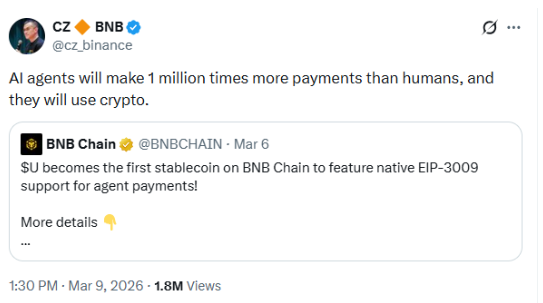
Changpeng Zhao, better known as CZ, recently said AI agents will make far more payments than humans and that crypto will likely become their native payment rail. That claim sounds bold at first. But when you step back and look at the size of today’s global financial system, it starts to look less like hype and more like an early signal.
The world economy is enormous. IMF data places global nominal GDP at roughly $117 trillion in 2025. But the movement of money already extends far beyond the value of goods and services produced each year. An IMF paper published in 2025 estimated that global cross-border traditional and crypto payments approached $1 quadrillion in 2024. On top of that, the Bank for International Settlements reported that daily FX turnover reached $9.6 trillion in April 2025, a scale that annualizes to well above $2 quadrillion in trading activity. That does not mean all of it is “payments” in the everyday sense, but it does show that the rails of global value exchange are already operating at staggering scale.
That is where AI agents change the equation.
Humans make payments occasionally. AI agents could make them constantly. They can pay for compute, data, API access, logistics, cloud resources, software actions, advertising placement, supply chain events, and autonomous services in real time. In an agentic economy, one user request could trigger dozens or hundreds of machine-to-machine transactions behind the scenes. That is why the future may not simply be more digital payments. It may be a fundamentally new payment layer powered by software acting on behalf of people, companies, and devices.
The infrastructure is already moving in that direction. Deloitte has argued that agentic commerce could drive up to $17.5 trillion in commerce by 2030. McKinsey has likewise described agentic commerce as a major new channel, with AI agents beginning to browse, compare, and purchase on behalf of users. In other words, commerce is becoming executable by software, not just searchable by people.
Crypto fits naturally into that future for one practical reason: software agents do not bank like humans do. They need programmable, global, always-on settlement. Traditional payment systems were built around human identity, business hours, intermediaries, and jurisdictional friction. Crypto networks, stablecoins, and tokenized rails offer a different model: programmable money that can move instantly, globally, and machine-to-machine.
This does not mean every AI payment will happen on crypto tomorrow. It does mean the logic is becoming harder to ignore.
At Dectec, we believe the future of AI is not just about smarter systems. It is about ownership, access, and participation. If AI agents are going to transact, negotiate, and create value across the global economy, individuals and businesses should not be left on the sidelines. They should be equipped to own their AI, protect their data, and benefit from the new digital economy they are helping to build. That is the future Dectec is working toward. A future where decentralized AI and intelligent infrastructure empower people, not just platforms.